
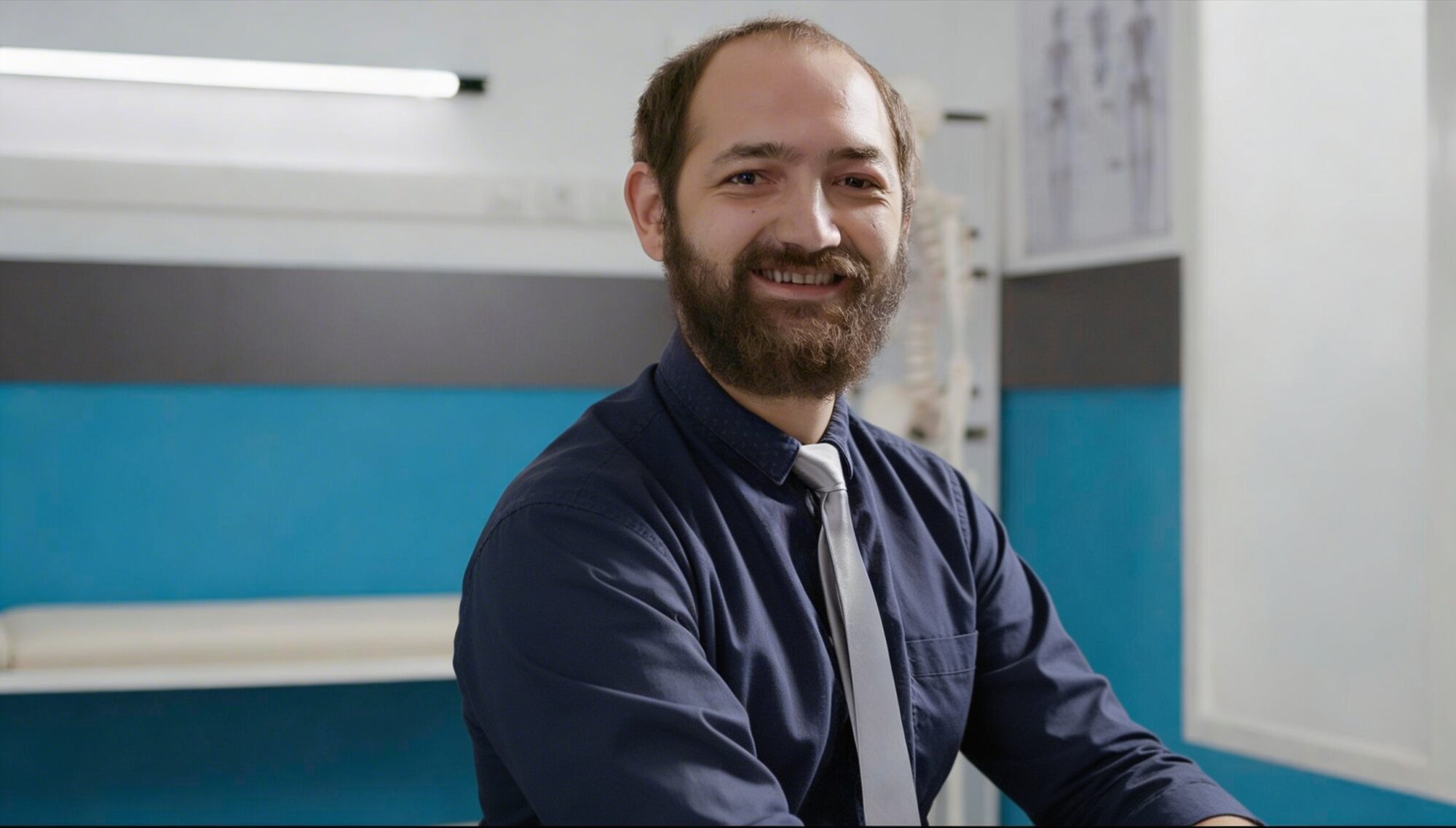
Principal Clinical Psychologist and Lead for Specialist Psychological Interventions, South Somerset
When we’re struggling with our mental health, finding the right support can often feel confusing and frustrating. We might know we need help, but knowing which door to knock on—and whether that door will actually open—is a different story altogether.
We recently sat down with Principal Clinical Psychologist Stuart Smith to talk about how Somerset is trying to change this. Stuart is the Lead for Specialist Psychological Interventions in South Somerset, and a therapist specialising in Cognitive Analytic Therapy (PDF). Today, he works within the NHS to help lead and shape mental health services, but he hasn’t always been inside the statutory system.
Before his current role, Stuart worked for the Somerset Drugs and Alcohol Service. Being outside the NHS gave him a clear view of the gap that can sometimes exist between NHS services and those provided by voluntary and community organisations. “Working outside the NHS really taught me how intimidating it can be to actually get into it,” Stuart says. “I remember the frustration and sense of disconnection.”
Stuart’s Day-to-Day Work
In his role, Stuart often finds himself sitting between the people making big decisions about funding and the staff working on the ground. On a typical day, he might be facilitating a therapy group or overseeing the assessments happening within his team. Much of his work is about modelling the way the Open Mental Health alliance works for other staff members and making the collaboration between the NHS and our voluntary sector partners run smoothly. Ultimately, he spends his time making sure the system works so that “there’s a door open that wouldn’t have been necessarily open before” for people in Somerset who need help.
Bridging the Gap
Through this work, Stuart seeks to close the gap between clinical NHS services and the support offered by local groups. He describes the NHS as having an “embarrassment of riches when it comes to statutory clinical knowledge and processes,” but that these same processes can make simple things difficult.
“Trying to keep a therapeutic garden going in the NHS is an absolute nightmare,” he jokes, “whereas our voluntary sector colleagues seem to be able to do it very, very easily.”
Open Mental Health was created to bridge this divide. It is an alliance of local community organisations working together with the NHS and Somerset Council to make sure there is no wrong door for support. This partnership means that if you are visiting a charity like Mind in Somerset, you are also connected to the wider Open Mental Health network, including the NHS.
Last year, this way of working led to over 80,000 interventions across the county. By joining things up, we’ve also helped see a 15% reduction in mental health-related A&E attendances.
Mental Health-Friendly Spaces
One of the most important things, Stuart says, is the need for what he calls “mental health-friendly spaces.” Whether it’s the Balsam Centre in Wincanton, Watch CIO in Chard, or the Foyer in Yeovil, these are places where we don’t have to pretend everything is okay.
“It’s a space where you don’t have to mask as much,” Stuart explains. “If you’re feeling a bit wobbly, you’re not necessarily going to feel as self-conscious as you might do elsewhere. You’re in a place where that’s going to be understood.”
Sometimes, just being in a supportive environment can lead to unexpected moments of hope. Stuart shared a story of someone who visited Crisis Safe Space during a very low point and happened to see a singing group meeting nearby. Becoming aware of that community gave them a reason to look beyond their immediate crisis and think about a future where they could belong again.
Scaffolding for Rebuilding Lives
Clinical treatment—like therapy or medication—is often just one part of the journey. Stuart believes the real work happens when we start rebuilding our lives, and this is where the OMH alliance acts as a scaffold.
“It’s not doing it for you, but it certainly makes it a little bit easier to do,” he says. This might mean finding a Dungeons & Dragons group, an arts-and-crafts class, or even a local dirt bike racing club. These activities aren’t just hobbies; they are the holistic elements that help us move from being a patient back to being a person with a full life.
By working as one team, Open Mental Health can offer the clinical expertise of the NHS alongside the social connection of the voluntary and community sector. As Stuart puts it, it’s about “giving us a range of options rather than just our lovely buildings and our wonderful processes.”
If you or someone you care about is struggling, please know that you don’t have to face it alone. Open Mental Health is here 24 hours a day, 7 days a week. Just call Mindline on 01823 276 892 or freephone 0800 138 1692 , and ask to be referred to Open Mental Health.