
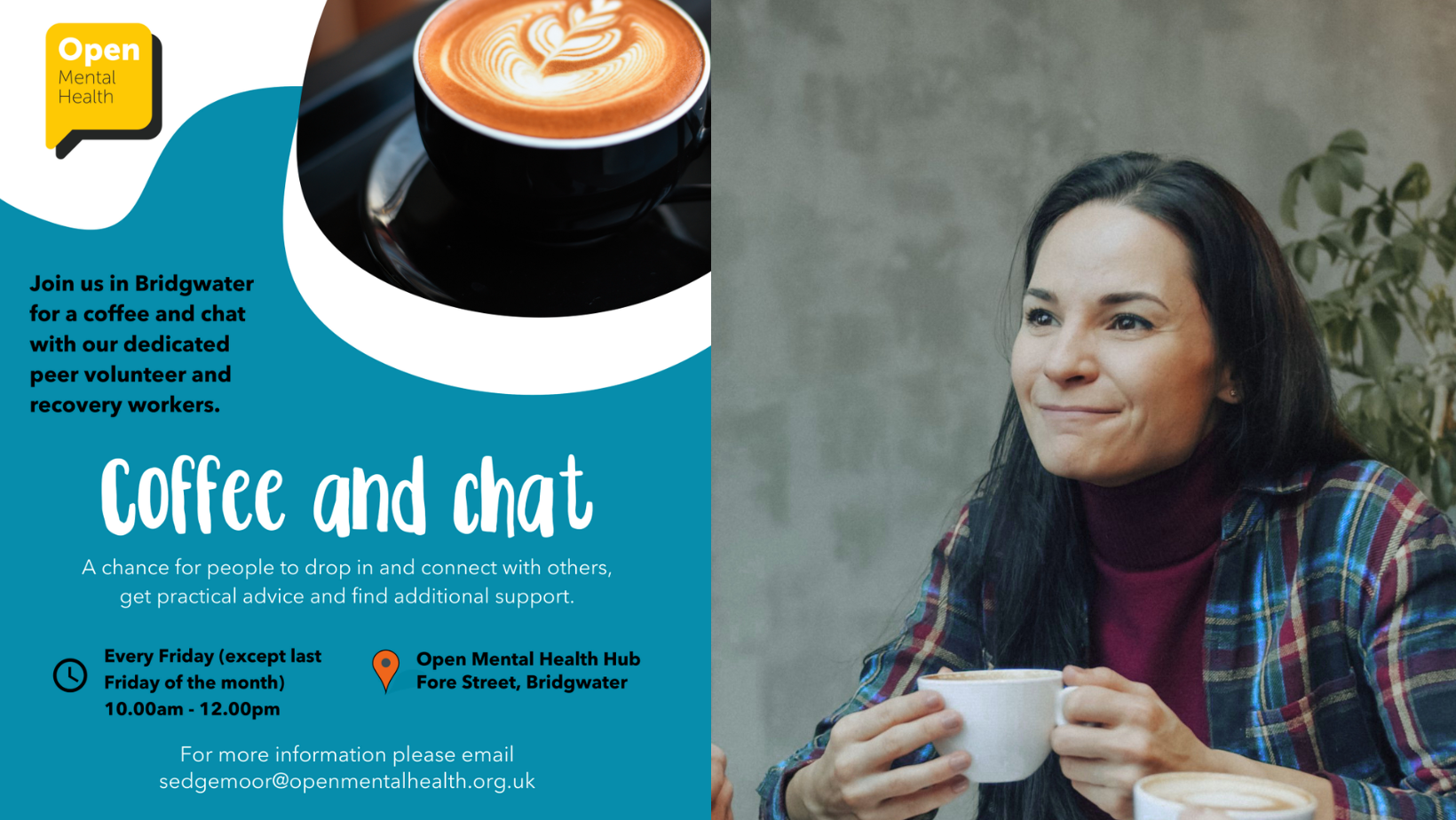
What are you doing Friday mornings? If you find yourself at a loose end and wishing you had somewhere relaxing and friendly to go, we know just the place: The Open Mental Health coffee morning held at the Wellbeing Hub, 2 Fore Street, Bridgwater, Somerset, TA6 3NF, every Friday from 10 am to midday, except for the last Friday of each month.
You can enjoy free drinks and friendly company in a welcoming atmosphere. Jo Poole, one of our Expert by Experience Leaders, and Robyn Butler of Second Step are the original organisers. Increasingly, Simon, a volunteer whose story we share later in the article, helps them. And there’s more than warm drinks and chat on offer, with games, books, colouring, and even a chance to get your nails done.
The coffee morning team are also on hand to listen and talk about local support options if you’re finding things difficult. “There are a few times I’ve asked questions to Jo and Robyn,” Simon explains, “and they’ve signposted me to where I need to go. So, it’s a one-stop shop really, and that great relationship building has led me onto different things.”
Counteracting Isolation and Loneliness
Ivor, a regular attendee, said, “The first day I came, Jo was right there. She’s a volunteer, and she’s absolutely brilliant. I’ve got terrible short-term memory problems due to amnesia nearly 40 years ago, so anything now, I just forget straight away. It’s very frustrating, because it cuts people off, and to me, that’s not correct.”
Experiencing mental health challenges can cause isolation. The symptoms, emotional exhaustion, judgmental reactions, and social stigma make it hard to keep relationships with friends and family going. The Mental Health Foundation’s Loneliness and Mental Health report explains that severe loneliness and poor mental health often make each other worse, but it can be hard to say which came first.
There can be many stereotypes too; people often think loneliness is caused by age or physical isolation, overlooking students, carers, people living in busy communities, and many others who find themselves isolated. Even in a room full of people we know, a sense of isolation can weigh us down.
“I live alone,” Ivor says, “and that’s not very pleasant at all. Some days I don’t see anybody.”
Loneliness leads to greater pressure on public services: people experiencing social isolation make more GP visits, have longer hospital stays, and are more likely to enter residential care. NHS guidance points out that the risk of both physical and mental health conditions increases with isolation.
The coffee mornings act as an antidote to isolation. Ivor explains, “You are allowed to express your feelings here. It’s non-judgemental. You don’t have to come along with any agenda. You can just talk if you want to, or you don’t have to talk—you can just be you.”
Simon adds that, “It’s like having an invisible hand holding yours to come along, and when you’re here, it gives you that real in-depth warmth.”
A Family of Friends
Claire has been attending the coffee mornings for a year. “It’s definitely lifesaving for me,” she says. “It keeps me out of crisis. As soon as I’m feeling a bit low, everyone in the group notices and asks if I’m okay. One time I needed more help, so they made sure I got it. It’s not just the people who volunteer and work here; it’s the other people who come here too. It’s the central part of my week, the thing I look forward to most. If this group didn’t exist, I don’t know that I would still be on the planet. It’s that important. So many people come, and it’s kind of like a family now. We have little offshoot groups now too, so some of us go to a quiz once a month, and we support each other. It’s life-changing.”
Life Changing Relationships
Simon agrees about the life-changing aspect: “I found out about the coffee mornings through Glanville House, and I came here with my key worker a couple of times. It’s really warm when you walk in. There’s no pressure. I could come here with no expectation, and it’s nice to have a drink and just chat with others. Now, I’ve got a group of friends from it.”
Simon reflects on the experience of being part of this warm and friendly group: “If I look back to when I first came here, I was very timid, nervous, and shy about being around people. This is what got me out of that. This group gave me that sense to be myself, helped point me in the right direction, and then allowed me to see that I can do things. This is my forever anchor; I could never not come.”
Over time, Simon has taken on more responsibility for running the coffee mornings, and he now helps to co-facilitate the group, “I wouldn’t have expected to do it. Robyn and Jo gave me the opportunity, and it’s helped me with my communication skills. It’s helped me understand what’s going on in other people’s worlds, not just mine. It’s peer support. Not just about me; it’s about how I can help others.”
The experience has led Simon to think of a new career path and to seek out additional skills: “I’m doing a peer support development programme at the moment. I came here really worried and nervous about volunteering, and now it could be five days a week. I’ve just completed a cookery course and got my certificate, plus my food hygiene level two. I cooked for ten people yesterday. I absolutely love it, and paying it back is what I’d like to do. I’ve needed support myself, and now it’s about paying back to other people.”
If you’d like to join this welcoming group, pop along one Friday morning. As Simon, Ivor, and Claire have said, there’ll be no pressure and no expectations. You can chat or just sit by yourself and perhaps read or do a puzzle. There’s no need to phone or book a place; just come along as you are.
If you’d like more support for your mental health, call Mindline Somerset on 01823 276892 or freephone 0800 138 1692 and ask to be referred to Open Mental Health. Alternatively, visit our contact page and send us a message. We’re here for you.